

Trending Now
 Govt of India approves Integrated Transport & Logistics Authority to drive Multimodal Planning
 PCMC approves ₹85 Lakh for DPR of Maharashtra’s First e-RTS Pilot Corridor
 Visakhapatnam partners with Moscow to build Technology-Driven Urban Transport System
 Biofuels in Shipping: A Transitional Solution or Long-Term Strategy?
 8 Reasons Why Trains Are Still One of the Best Ways to Travel
 Interview with Champak Panda, MD-Rolling Stock & Components, Alstom India
 Beyond the Tailpipe: The Case for African Electric Mass Transit
 A Rejected Claim Is Not Always the End, What Car Owners Can Do Next?
 Monsoon Bike Insurance Guide: Covers That Matter before the Rains Begin
 How Train Transportation Creates Faster and Smarter Cities
Interview with Champak Panda, MD-Rolling Stock & Components, Alstom India
UTN Online Desk
Posted on: 2026-05-20 08:00:00
Viewer: 15,479
Comments: 0
Country: India
City: Bengaluru
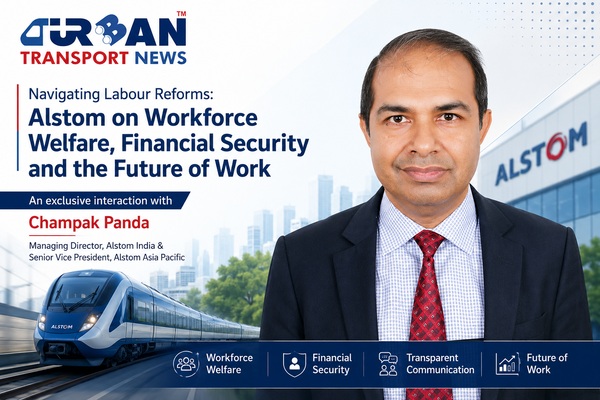
As India moves closer to implementing its new labour codes, organizations across sectors are evaluating their impact on workforce management, employee welfare, and long-term talent strategies. In this exclusive interaction with Urban Transport News, Champak Panda of Alstom shares his perspectives on how the evolving regulatory framework is reshaping workplace practices and compensation structures. He discusses the implications of the labour reforms on employee benefits, provident fund contributions, gratuity, and overall financial security, while highlighting the importance of transparent communication during the transition. The conversation also explores how labour code reforms could influence talent attraction, retention, skilling, and workforce planning in the manufacturing, engineering, and mobility sectors, offering valuable insights into the future of work in India.
Alstom’s footprint in the global mobility space is well recognized. How significant is the contribution of the India-based components business to Alstom’s global railway and metro projects?
As a global leader in sustainable and innovative rail mobility solutions, Alstom offers a broad portfolio of premium components and solutions. Our components are designed for many rolling stock applications, including non-Alstom trains, to increase performance needs and elevate the operational efficiency of any fleet and customer. Globally, we have over 50 years of experience and references in more than 60 countries of providing world-class components capable of operating across networks. With growing trust in India’s manufacturing capabilities and quality, more and more countries are open for the Indian imports. We are supporting our global teams with metro trains, car body shells, bogies, traction and auxiliary converters, looms and cabinets built in India.
Today, our Coimbatore site is the largest components manufacturing facility for Alstom, in Asia and is dedicated to improving industrial efficiency in manufacturing components for various prestigious national and international projects. This has enabled us to become a leading supplier of components across major sites in 5 continents – Asia, Australia, Europe, North America, and South America. Together with the Maneja site, which supports over 20 projects globally, India remains a strategic hub for Alstom, driving forward its global rail ambitions through cutting-edge technology, sustainability, and operational excellence.
Could you give us an overview of the key components being manufactured by Alstom India that are used in global rolling stock platforms?
In India, Alstom has engineering and industrial presence for components with the sites of Bangalore, Savli, Coimbatore and Maneja. We offer the best solution available to original equipment manufacturers, operators and asset owners, for increasingly safe and environmentally friendly travel. Our range of state-of-the-art and proven systems and products includes bogies, motors, dampers, brake friction, switchgear, traction and auxiliary converters, Looms and cabinets, transformers, green traction solutions, interiors, train control and information management systems.
What design or engineering innovations have been integrated into Alstom-built components to enhance energy efficiency and reduce lifecycle costs?
Alstom incorporates cutting-edge design and engineering innovations into its components to boost energy efficiency and minimize lifecycle costs. We achieve this by focusing on several key areas such as eco-design principles, advanced smart technologies, and effective lifecycle management. These efforts include optimizing electric braking systems for energy recovery, using environmentally friendly materials, lowering emissions and noise levels, and creating designs that facilitate easy dismantling and repair.
For example, our lightweight bogie designs, utilizing advanced composite materials, reduce overall train weight, leading to significant energy savings over the lifespan of the rolling stock. We've also implemented regenerative braking systems that capture and convert kinetic energy back into electricity, feeding it into the grid, effectively turning braking into a power source. Our modular component architecture allows for easier maintenance and replacement of individual parts, drastically cutting down on repair times and associated labour costs, thus lowering the total cost of ownership. By using aerodynamic profiling in our car body shells, we minimize drag, which directly translates to reduced energy consumption at higher speeds. Ultimately, these advancements translate into significant operational savings and a greener footprint for our customers worldwide, proving that efficiency and sustainability go hand-in-hand at Alstom
How do Alstom’s components contribute to improved reliability and availability of trains and metro systems across international markets? Can you share specific examples or case studies?
Reliability and availability are central to Alstom’s mission of delivering world-class mobility solutions. Our components are engineered with cutting-edge technologies, rigorous quality standards, and robust designs to ensure availability and seamless operations for trains and metro systems across the globe.
Here are a few examples: our fail-safe redundant systems in critical components, such as traction inverters, ensure continuous operation even in the event of a partial system failure, maximizing uptime. We employ advanced material science in components like our bogies, using alloys that resist fatigue and corrosion, extending their operational life in diverse climates and conditions. Through extensive simulation and real-world testing in our state-of-the-art facilities, we push our components to their limits, guaranteeing their resilience and reliability under extreme operational demands. Our standardized interfaces and plug-and-play component design simplify maintenance procedures, allowing for quicker diagnostics and part replacement, thereby improving overall availability. These innovations are why Alstom components are synonymous with operational excellence and the assurance of continuous service for operators across international markets, ensuring the world keeps moving, reliably and efficiently.
How is Alstom leveraging digital technologies or predictive maintenance tools in its components to ensure smarter and safer rail mobility?
Alstom is harnessing the power of digital technologies to advance smarter, safer, and more efficient rail mobility. By embedding predictive maintenance tools and IoT-enabled solutions into key components such as traction systems, auxiliary converters, bogies, and brake systems, we empower operators to enhance safety, reduce unplanned downtime, and optimize performance. These components are equipped with sensors that continuously monitor real-time performance, environmental conditions, and operational parameters. Data is analysed using AI-driven algorithms and big data analytics to detect anomalies, predict failures, and enable timely interventions. For instance, traction systems are monitored for power delivery and energy efficiency, while auxiliary converters with built-in synchronization systems, track energy consumption and mechanical wear to ensure high power availability and operational continuity.
Bogies and brake systems also benefit from digital monitoring, tracking mechanical stress, and braking efficiency to maintain safety and reliability throughout their lifecycle. Supporting this ecosystem is Alstom’s Digital Experience Centre in Bengaluru, which develops predictive maintenance solutions for over 120 global projects. Leveraging AI, cloud computing, and advanced telecom technologies, the centre enables data-driven decision-making, lowers maintenance costs, and extends component lifespan. This digital transformation reflects Alstom’s commitment to delivering future-ready, high-reliability rail solutions.
What capabilities make Alstom’s Indian manufacturing units globally competitive for component supply? How do you ensure consistency in quality, despite diverse end-user requirements?
Our cutting-edge infrastructure, skilled talent, and a strong focus on innovation has placed Alstom’s manufacturing facilities in India as vital hubs for the global supply of rail components. Rigorous testing using digital simulators and modular designs ensure products meet the highest global standards for safety, reliability, and performance.
The Coimbatore facility, equipped with advanced technologies, produces and tests wide range of high-quality components, all under one roof. Efficiency has been significantly enhanced through automation, such as a conveyorized traction loom assembly line that cut throughput time by 70% and improved productivity by 20%. Around 50% of Coimbatore’s output is exported, serving over 12 countries across five continents. A nearly 100% localized supply chain further ensures cost-efficiency and resilience, aligning with ‘Make in India’ and ‘Atmanirbhar Bharat’ initiatives.
Complementing Coimbatore's capabilities, our Maneja site stands as an important hub for cabinet and traction equipment manufacturing, actively contributing to over 20 global projects. This facility's specialized expertise ensures the delivery of robust and high-performance components, solidifying India's position as a central hub of Alstom's global production network.
Alstom’s components from India are used in projects across Europe, Australia, the Middle East and more. How do you tailor component design and production to meet varying international standards and regulations?
We support over 44 global projects from India, which is a testament to the manufacturing and engineering excellence of Alstom India. We work in close collaboration with our global technical centres and project teams to ensure alignment with international standards and customer needs. Our components are engineered to adapt to specific market requirements, without compromising on core performance.
What role do automation, robotics, or Industry 4.0 play in enhancing the precision and scalability of your component manufacturing operations?
Automation and Industry 4.0 principles play a vital role in enhancing precision, scalability and efficiency in component manufacturing. It has significantly improved quality and consistency by reducing human error and ensuring adherence to Alstom’s stringent global standards. To drive capacity enhancement, we have deployed advanced robotics across our key sites where we have substantially increased the coverage of robotic Spot and MIG welding at Savli. Complementing these capabilities at our Maneja site we have automated critical processes for Power Modules such as grease application and torquing using robots. Furthermore, we have upgraded the water testing process for traction components to a robotic system at Coimbatore. These interventions allow us to scale our operations rapidly while maintaining the high precision required for global export projects.
How are you incorporating sustainability into the design and manufacturing of rolling stock components? Are there efforts to reduce the carbon footprint of components supplied globally?
Sustainability is central to Alstom’s component strategy, shaping every stage from design and materials to manufacturing and delivery. Eco-design is our approach that aims to incorporate environmental considerations during the design phase of a product, service or building, with the primary goal of limiting the lifetime environmental impact. The eco-design approach involves analysing the product lifecycle from design to recycling in order to predict its effects on the environment at each stage.
By embedding responsible innovation at the core of Alstom’s R&D, eco-design reduces environmental impacts through the value chain of our trains and solutions, delivering operational efficiency through the entire life cycle of a solution. Faced with sustained population growth, the imminent surge in global traffic and the growing impact of transport on the environment, eco-design is fast becoming one of the main solutions for sustainable transport.
As a ‘Make in India for the World’ champion, what has been your approach to localization in materials sourcing and supply chain development?
With an extensive footprint of 6 manufacturing facilities, 5 engineering centres and over 12,700 highly engaged employees in India, we continue to strengthen our domestic presence, through indigenous engineering and manufacturing, as well as performing successful international deliveries. Today, we are the most localized Indian MNC and with our extensive offerings and domestic footprint. With our strong local knowledge and extensive investments in industrial and human capital over the years, we are well-positioned and committed to supporting the realization of the ‘Make in India’ and ‘Atmanirbhar Bharat’ vision. Our nearly 84% localized supply chain supports the timely delivery of world-class solutions across the globe.
Alstom invests in technical support, knowledge sharing, and advanced manufacturing technologies to align partner capabilities with its stringent requirements. This has fostered a robust supply chain ecosystem capable of delivering components that meet diverse international specifications.
How is Alstom India building talent pipelines and upskilling engineers to work on next-generation railway technologies?
Alstom is leading the way to greener and smarter mobility, by focusing on sustainable growth, green and digital innovation, and operational efficiency. We invest heavily in nurturing and training talent across levels, from young graduates to engineering experts to senior leaders who are contributing to smart and sustainable mobility.
At Alstom, we value curious and innovative people who are passionate about working together to reinvent mobility, making it smarter and more sustainable. Our focus on sustainable mobility with our projects and opportunities across the globe, and our foray into innovative technologies are key factors in being able to attract and retain talent.
We have focused initiatives in India especially aimed at attracting engineering graduates through our flagship Young Engineering Graduates Program (YEGP). We are hiring young engineers from top engineering colleges across all of India, with a focus on regional & diverse (women engineers) talent. Since 2015, we have hired 1400+ Young Engineers. Additionally, there is also focused hiring of engineering interns who are a part of Alstom India’s internship program, ‘Anubhav’.
Through our Work Integrated Learning Program (WILP), we also encourage higher education by sponsoring an M.Tech program from BITS Pilani, a premier Engineering Institute, spread over 2 years. The specialized courses include – Artificial Intelligence & Machine Learning, Data Science Engineering, Design Engineering, Embedded System, Manufacturing Management, Quality Management and Software Systems.
At Alstom, we provide continuous learning and career development opportunities to our employees, ensuring they stay up to date in their current role.
Can you share some of the latest innovations or breakthroughs from the Rolling Stock & Components division that we can expect to see on upcoming global projects? Looking ahead, what are the strategic focus areas for your division in the next 3–5 years in terms of technology, capacity, and global integration?
Trains are evolving to become more intelligent and sustainable than ever before. Through AI and our HealthHub platform for predictive maintenance, we can now diagnose and resolve potential issues in rolling stock before they affect operations, making trains and their systems more reliable for passengers. We are also leading the way in green mobility with advanced battery-operated trains designed for non-electrified routes in remote and challenging terrain. A prime example is the Adessia fleet for New Zealand, proudly manufactured in India at Alstom’s Savli site.
Looking ahead, our strategic focus for the rolling stock division over the next few years is to scale these innovations globally, of course, not losing sight of the opportunities we see for the India market. We will deepen AI and IoT integration to further enhance fleet performance and efficiency. Our goal is to deploy these solutions across more than 150,000 vehicles in service worldwide. To support global integration, we will continue to build on our expertise and India’s role as a vital engineering and manufacturing hub for mobility, delivering world-class sustainable technologies to our customers and consumers everywhere.

UTN Online Desk
Urban Transport News provides real-time updates for all modes (Railways, Roadways, Waterways & Airways) of the Transportation and Urban Infrastructure Industry.