

Trending Now
 Interview with Champak Panda, MD-Rolling Stock & Components, Alstom India
 Beyond the Tailpipe: The Case for African Electric Mass Transit
 A Rejected Claim Is Not Always the End, What Car Owners Can Do Next?
 Monsoon Bike Insurance Guide: Covers That Matter before the Rains Begin
 How Train Transportation Creates Faster and Smarter Cities
 PM Modi inaugurates Noida International Airport, Boosting North India’s Multi-Modal connectivity
 Things You Can Do While on Long Train Rides: Stay Productive, Relaxed, and Entertained
 Rail Chamber launches 2026–27 National Membership Drive to strengthen Asia’s Railway Ecosystem
 North-South Commuter Railway (NSCR): Modern Train Network Connecting Luzon Island
- India launched Bharat Taxi Service as First Cooperative-Owned Digital Mobility Platform
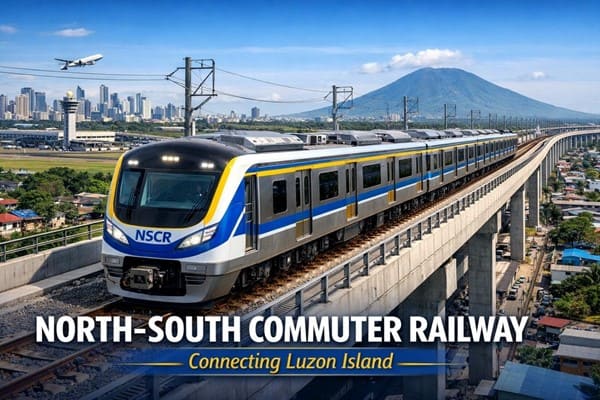
North-South Commuter Railway (NSCR): Modern Train Network Connecting Luzon Island
Krishtina D'Silva
Posted on: 2026-02-09 09:01:00
Viewer: 9,411
Comments: 0
Country: Philippines
City: Manila
The North-South Commuter Railway (NSCR) is the Philippines’ most ambitious rail infrastructure project in decades, poised to redefine public transportation across the island of Luzon. Designed to link Central Luzon, Metro Manila, and the CALABARZON region, this transformative railway promises faster, greener, and more efficient travel for millions of Filipinos and visitors alike.
Meanwhile, if you want to play Filipino card games such as Tongits, Pusoy in English, Pusoy Dos and other international card games online, visit GameZone.
What is the NSCR?
The NSCR is a 147-kilometer elevated commuter rail line being built to connect Clark, Pampanga, in the north and Calamba, Laguna, in the south, passing through key economic and population centers across Luzon.
Officially part of the Philippine Government’s infrastructure flagship projects, NSCR aims to modernize mobility, ease traffic congestion on major highways, and support economic growth along its corridor.
Strategic Importance of NSCR for Luzon
Luzon is the most populous island in the Philippines and home to the National Capital Region (Metro Manila), which experiences chronic traffic congestion. The NSCR addresses this by providing a high-capacity, high-speed rail alternative to road transport. Its strategic importance includes:
1. Regional Connectivity
The NSCR will serve as a backbone for commuter and intercity travel across three major regions—Central Luzon, Metro Manila, and CALABARZON—creating seamless mobility that integrates residential, commercial, and industrial zones.
2. Integration with Other Transit Systems
One of the hallmark features of NSCR is its integration with the Metro Manila Subway Project (MMSP). This linkage will allow passengers to transfer between regional and urban rail systems without significant delays, further enhancing accessibility across Luzon’s transport network.
NSCR Route and Key Sections
The NSCR covers a comprehensive route with 35 stations, strategically located across densely populated and fast-growing cities and municipalities. While exact station names and sequences may vary as construction progresses, the rail line includes:
-
Clark International Airport—a northern mobility hub connecting the capital region to global destinations.
-
Valenzuela City—a key urban center in Metro Manila’s northern fringe.
-
Metro Manila Central Segment—serving major residential and business districts.
-
Calamba City—a southern endpoint that links the project to additional future rail expansions.
This alignment supports balanced development across regions and reduces travel dependence on road-based vehicles.
Train Services and Speed
The NSCR will feature two types of rail services:
1. Commuter Train Service
-
Designed to serve daily riders with frequent stops at all major stations.
-
Each commuter trainset can carry up to 2,242 passengers, making it ideal for peak-hour traffic.
2. Limited Express Train Service
-
Aimed at longer-distance travelers and regional commuters.
-
These trains will reach speeds of 120–130 kilometers per hour (km/h), significantly reducing travel times compared to conventional road transport.
With speeds far exceeding current averages of 20–40 km/h on congested roads, the NSCR will transform how people travel across Luzon.
Travel Time Improvements
One of the most compelling benefits of the NSCR is its dramatic reduction in travel times:
-
Clark to Calamba travel is expected to shrink from about four hours by road to approximately three hours by commuter rail, and even less via express services.
-
Clark to Alabang may be cut to around two hours by limited express trains, a significant improvement over current traffic-dependent travel times.
These improvements will help commuters, travelers, and businesses move more efficiently across the island.
Ridership and Economic Impacts
Once operational, the NSCR is projected to benefit as many as 800,000 passengers daily in its opening years, with the capacity to serve up to one million commuters as demand grows.
The project is expected to:
-
Boost local economies by enhancing access to jobs, education, and services across regions.
-
Reduce road congestion and pollution by shifting commuter traffic to rail.
-
Promote commercial development along station corridors.
The presence of rail infrastructure has historically spurred property development and business investments along transit lines, and the NSCR is poised to unlock similar opportunities.
Construction Status and Timeline
Construction of the NSCR is already underway and progressing through advanced stages. The project phases include:
Pre-operations
-
Scheduled to begin in March 2026 and extend through July 2027.
Partial Operations
-
Phase 1, from Clark International Airport to Valenzuela (13 stations), is expected to commence in December 2027 and run until September 2028.
Full Operations
-
After additional expansion through Phase 2 (to Nichols and further to Calamba), full operations are slated to begin by January 2032.
Timelines may adapt to construction progress, right-of-way challenges, and other logistical factors, but the trajectory places the NSCR as a major operational system by the early 2030s.
Funding and Partnerships
The NSCR project is a collaborative effort led by the Department of Transportation (DOTr) and the Philippine National Railways (PNR) with substantial financial and technical support from the Japan International Cooperation Agency (JICA) and the Asian Development Bank (ADB).
The operations and maintenance segment alone involves a public-private partnership (PPP) contract valued at approximately ₱229.3 billion, illustrating strong private sector participation in long-term rail system sustainability.
Long-Term Vision: A Connected Luzon
While the NSCR itself is a massive undertaking, it is part of a broader vision to create a nationally integrated rail network across Luzon. Future extensions could link to longer-distance services and other economic corridors, further reducing travel times across regional lines.
By knitting together major cities and economic zones, the NSCR lays the foundation for a smarter, more connected Luzon Island, where mobility drives growth without clogging roads or increasing environmental strain.
Conclusion
The North-South Commuter Railway (NSCR) is more than just a rail line—it’s a transformative project that will reshape travel, commerce, and daily life across Luzon Island. With its modern infrastructure, seamless integration with existing transit systems, and far-reaching economic impact, the NSCR stands as a critical pillar of the Philippines’ infrastructure future.
As construction progresses and operations begin in phases, millions of passengers will soon enjoy faster, safer, and more sustainable mobility. In the long run, the NSCR will help decongest roads, strengthen regional economies, and support balanced national development by connecting communities, industries, and opportunities across Luzon.


Krishtina D'Silva
Krishtina D'Silva is working with Urban Transport News as Special Correspondent (International News division). She posses a Master's degree in Journalism from New York University and responsible for covering updates from the urban mobility