

Trending Now
 Interview with Champak Panda, MD-Rolling Stock & Components, Alstom India
 Beyond the Tailpipe: The Case for African Electric Mass Transit
 A Rejected Claim Is Not Always the End, What Car Owners Can Do Next?
 Monsoon Bike Insurance Guide: Covers That Matter before the Rains Begin
 How Train Transportation Creates Faster and Smarter Cities
 PM Modi inaugurates Noida International Airport, Boosting North India’s Multi-Modal connectivity
 Things You Can Do While on Long Train Rides: Stay Productive, Relaxed, and Entertained
 Rail Chamber launches 2026–27 National Membership Drive to strengthen Asia’s Railway Ecosystem
 North-South Commuter Railway (NSCR): Modern Train Network Connecting Luzon Island
- India launched Bharat Taxi Service as First Cooperative-Owned Digital Mobility Platform
Germany celebrates 30 years journey of High Speed Rail
Maria Rose
Posted on: 2021-05-28 10:15:00
Viewer: 7,708
Comments: 0
Country: Germany
City: Berlin
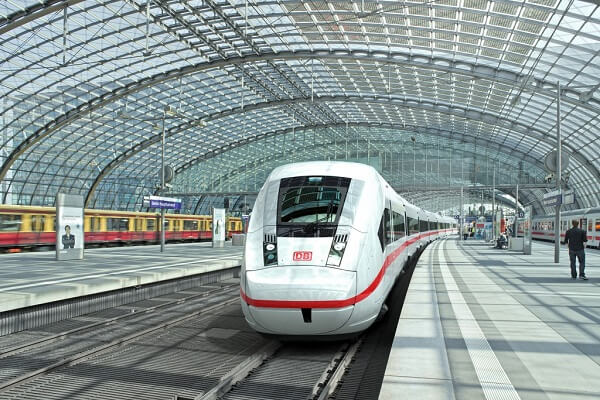
Berlin, Germany (Urban Transport News): Thirty years ago, on May 29, 1991, six ICE 1 trains converged in Kassel-Wilhelmshöhe from different directions and officially inaugurated the era of high-speed rail travel in Germany. A few days later, on 2 June 1991, the first ICE trains officially inaugurated high-speed service in Germany. The new Hanover-Würzburg and Mannheim-Stuttgart high-speed lines slashed travel times on north-south connections by up to two hours.
Over the following years, the ICE family was further developed and expanded: The ICE 2 debuted in 1996, followed by the ICE 3 four years later. While ICE 1 and ICE 2 were developed and built with the participation of Siemens, the ICE 3 was a complete Siemens in-house development. It was also the first high-speed train used for cross-border service to the Netherlands, France and Belgium, being designed for four different operating voltages and the various train protection systems. The ICE 3 was Germany’s first high-speed train to reach a top speed of over 300 km/h. All drive components were distributed completely beneath the floor, allowing the seating capacity to be significantly increased.
In 2016, the ICE 4 from Siemens Mobility ushered in a new era in ICE service for Deutsche Bahn. With its flexible configurations and generous interior space (918 seats in a 13-car unit), the ICE 4 has become the new backbone of Germany’s long-distance system. The trains have a top speed of 250 km/h (up to 265 km/h in the future).
The ICE 4 order was the largest in the history of Siemens Mobility. A new ICE 4 is currently being added to Deutsche Bahn’s long-distance fleet every three weeks, and by 2024, Siemens Mobility will have delivered a total of 137 ICE 4 trains. In July 2020, Deutsche Bahn awarded Siemens Mobility an additional order for 30 ICE Neo (Velaro MS) trains. Technically, the new train is based on the proven Velaro platform of the ICE 3.
Facts and figures:
- An ICE consists of around 5,800 components provided by 320 suppliers. This adds up to roughly 40,000 parts, along with more than 320 kilometers of cables and 18 kilometers of welds per train, plus more than 630 test documents totaling over 30,000 pages. (*ICE 3, Class 407, as an example)
- The trains are notable for their longevity, with a service life of more than 30 years. The ICE "Gütersloh" e.g. is an ICE 1 (class 401), has the multiple unit numbers 158 and was put into service in June 1991. Since then, it has reliably reeled off around 15 million kilometers, which is roughly 39 times the average distance from the earth to the moon (384,000 kilometers).
- The recycling quota for ICE trains is more than 95%. The quota for the ICE 3 (Class 407), for example, is 98.1%.


Maria Rose
Maria Rose is an Independent Technology Journalist in London, United Kingdom. She is currently working with Urban Transport News as Special Correspondent in International News Division.